Bitcoin mining energy consumption: does mining waste energy?
When it's surplus power, and when it isn't
In short. Bitcoin mining energy consumption is big, and in a sense deliberate: the electricity is what makes the ledger expensive to fake. Cambridge estimates about 138 TWh a year (roughly 0.5% of the world's electricity), and a preliminary preview points to about 190 TWh by the end of 2025. "Surplus energy" is real (curtailed wind and solar, hydropower, flared gas) but it is only part of the story. And many of the numbers you see, for or against, come from people with something at stake: here is who says what.
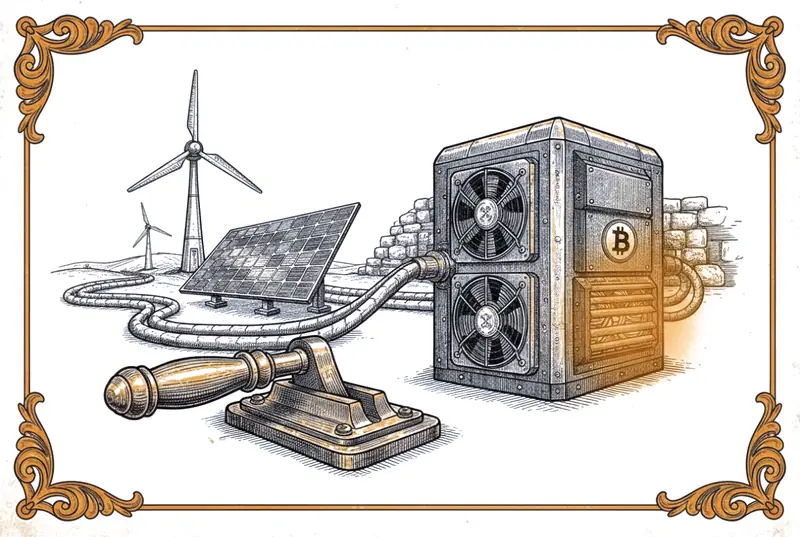
Search for "bitcoin mining energy consumption" and you land in two camps: headlines about country-sized waste, and claims that miners only use power nobody wanted. Both are partly right. Below you get the basics, the data (checked on 14 October 2026), US, UK and Canadian examples of surplus power, and a way to spot a biased number.
What is bitcoin mining, and why does it use energy?
Quick answer: miners are computers that keep Bitcoin's ledger in order, and the electricity they burn is what makes cheating costly.
Miners run a never-ending contest: they try an enormous number of guesses until one finds the winning combination, adds a block of transactions to the ledger and collects a reward in bitcoin. It's called proof-of-work, and it works like a lottery where cleverness doesn't help: you can only keep trying, and every try costs electricity.
That is the point. According to the original Bitcoin whitepaper, anyone who wanted to alter an old block would have to redo the work of that block and of every block after it, and then outrun the honest miners. The same text names what is spent: CPU time and electricity. So energy isn't a side effect. It's the part that protects the ledger. And because the reward is paid in bitcoin, the more it is worth, the more machines are worth switching on.
How much energy does bitcoin mining consume?
Quick answer: a lot. Cambridge's estimate is about 138 TWh a year, around 0.5% of global electricity.
A terawatt-hour (TWh) is a billion kilowatt-hours. The Cambridge Digital Mining Industry Report (April 2025) estimates 138 TWh a year, up 17% on the year before, or 0.54% of global electricity. A preliminary preview from the same Cambridge centre, presented at a forum in Dallas and reported by trade press on 25 July 2026, points to about 190 TWh a year in December 2025; the full report is due later. Digiconomist shows 204.44 TWh (read on 14 October 2026; the page shows no date) using a different method, which starts from miner revenue and an assumed 5 cents per kWh. Nobody meters every machine, so these are all estimates.
Comparison, for scale only: the IEA estimates that global data centres used around 415 TWh in 2024, about 1.5% of global electricity. Cambridge's 138 TWh is about a third of that, the 190 TWh preview about 46% (our arithmetic). A comparison tells you size, not whether the use is worthwhile: pick a different yardstick and the headline changes.
Is bitcoin mining powered by renewable energy?
Quick answer: partly, and the share depends on who is counting.
In Cambridge's survey (49 firms, covering 48% of the network's computing power) 52.4% of the electricity is "sustainable" (42.6% renewables and 9.8% nuclear), natural gas is the biggest single source at 38.2% and coal is 8.9%. These are 2024 figures reported by the companies themselves. Cambridge puts emissions at 39.8 million tonnes of CO2 equivalent a year (about 0.08% of the global total), or 69.6 million with a different, IP-address-based model; Digiconomist says 114.03 million. In the 2026 preview the low-carbon share rises to 59.4% and hydropower overtakes gas as the top source, but those numbers are preliminary.
What does "excess energy" mean in bitcoin mining?
Quick answer: power that, at that moment and in that place, nobody is buying or nobody can deliver to buyers. A miner can be installed almost anywhere and, say its supporters, switched off quickly, which is why it can act as a customer of last resort. There are three documented types.
What is curtailment, the wind and solar that gets switched off?
When wind and solar produce more than the grid can use or carry, the operator asks plants to produce less. That is curtailment. The US EIA reports that California curtailed 3.4 million MWh (3.4 TWh) of wind and solar in 2024, 29% more than in 2023 and 93% of it solar. Had every kilowatt-hour gone to miners it would have been about 2.5% of Cambridge's 138 TWh (our arithmetic): real, but small.
In Great Britain the problem is wires, not oversupply. NESO, the system operator, explains that wind in the north can't always reach demand in the south, so it pays wind farms to switch off and pays other plants to switch on. Its August 2026 report puts wind curtailment at 413 GWh, 9.4% of the wind that could have been generated (13.3% in July 2026, 15.5% in August 2025). NESO doesn't mention mining; to use that power a machine would have to sit on the constrained side of the grid.
Texas is the documented case where miners did switch off. According to the MIT paper discussed below, during Winter Storm Elliott (December 2022) the large flexible loads in ERCOT's curtailment programme, almost all of them miners, cut about 1.4 GW. The authors add that the climate benefit of this kind of service is hard to measure.
What about hydropower?
Cheap hydro attracts miners, but surplus isn't guaranteed. In June 2018 Hydro-Québec paused processing service requests from crypto miners because demand exceeded capacity (that was 2018; check current rules). In Italy, a startup called Alps Blockchain puts miners inside hydroelectric plants and says up to 30% of a plant's output can go to mining, per Italian outlet greenme.it: company figures, not independently verified.
What about flared gas?
Oil wells also bring up gas; where there are no pipes or plants to sell it, it gets burned in a flare. The World Bank's 2026 tracker says 167 billion cubic metres were flared in 2025, worth an estimated $54 billion: the third annual rise in a row and the highest since 2019 (the page doesn't mention bitcoin). The mining idea is to run a generator at the well. Crusoe Energy, a US company quoted by Argus Media in 2021 for sites in North Dakota and Montana, says this cuts CO2-equivalent emissions by up to 63% compared with flaring: a company figure. Critics, as summarised by MIT, say it leaves the underlying fossil-fuel production untouched and may prolong it. The same paper cites a Science study estimating that US flares, counting unlit flares and incomplete combustion, destroy methane at 91.1% overall, not the 98% usually assumed.
What do independent studies and critics say?
Quick answer: that consumption is huge, that some benefits are real but hard to measure, and that reassuring figures need checking.
The closest thing to a neutral reading is MIT CEEPR working paper 2023-11, "Climate Impacts of Bitcoin Mining in the U.S." (June 2023). What it actually says:
- It analysed 13 listed miners operating in the US, about a quarter of the network at the end of 2022. Their electricity has a carbon intensity of 397 g CO2/kWh, almost the same as the US grid average (387), and their emissions (7.2 million tonnes a year) exceed Vermont's. The calculation uses average grid factors, not specific contracts.
- The Bitcoin Mining Council, an industry body, says 58.9% of mining energy is sustainable; the authors call that survey-based and unverifiable.
- Possible benefits (flexible load for the grid, flared gas, orphaned wells, renewables) are hard to quantify, and there is no complete record of miners who built new renewable capacity. Heat reuse looks limited to pilot projects.
- The answer is transparency and disclosure, to avoid greenwashing without assuming every kilowatt-hour is bad.
Limits: it is a working paper, so CEEPR says it has no selection or peer review; it covers the US and end-2022 data; and three of the authors say they co-founded a company that sells sustainability metrics for digital assets.
How do I spot a biased number?
Quick answer: ask who is speaking, how they measured, and exactly what they are talking about.
Four questions for any figure: who is giving it and what do they gain? How was it measured (survey, model, direct metering)? What period and region? And is it about renewable energy, excess energy or zero-emission energy? Those are three different things: "59% renewable" doesn't say where or when the power is used, or whether it would have been used anyway.
| Who | What they say | How to read it |
|---|---|---|
| Cambridge (university) | 138 TWh; 52.4% sustainable | Survey of 49 firms, 48% of the network; surveys favour those who report |
| Digiconomist | 204.44 TWh | Economic method: miner revenue plus an assumed 5 cents/kWh |
| Bitcoin Mining Council (industry) | 58.9% sustainable (end 2022, cited by MIT) | Survey-based; MIT says unverifiable |
| Crusoe Energy (company) | Up to 63% lower emissions than flaring | Company figure |
| Alps Blockchain (company) | Up to 30% of a plant's output to mining | Company-supplied data |
| MIT CEEPR | 397 g CO2/kWh | Not peer reviewed, 2022 data, US only |
So, does bitcoin mining waste energy?
Quick answer: it depends on what you call waste and which power you mean.
Three honest answers. First: it is a huge, deliberate use of electricity. If you think a money system outside any government's control isn't worth that power, you'll call it waste; if you think it is, you'll call it the price of security. That's a value judgment, not a data point. Second: surplus energy exists and miners sometimes use it (Texas during grid stress, some flared gas, some hydro), but independent work says the climate benefits are hard to measure, and US-listed miners sat at the grid average. "It only uses wasted energy" and "it's boiling the planet" both oversimplify. Third: surplus isn't a fixed stock. Grids change, as Quebec's 2018 pause shows. Whenever you see a number, ask: from whom, and measured how?
Frequently asked questions
How much energy does bitcoin mining consume?
About 138 TWh a year according to Cambridge (April 2025 report, machine data from mid-2024), or 0.54% of global electricity. A preliminary preview of the same centre points to about 190 TWh in December 2025. Digiconomist estimates 204.44 TWh with another method. They are estimates, not meter readings.
Is bitcoin mining wasted energy?
It depends on your viewpoint. The electricity is the cost that protects the ledger, so it is deliberate. Some mining uses power that would otherwise be curtailed or flared, but not all of it, and the climate benefits are hard to measure, according to MIT.
Is bitcoin mining powered by renewable energy?
Partly. In Cambridge's survey 52.4% of the electricity is "sustainable" (42.6% renewables, 9.8% nuclear) and 38.2% is natural gas. That is self-reported by the firms that answered; the 2026 preview says 59.4% low-carbon, but it is preliminary.
What is excess energy in bitcoin mining?
Power that nobody is buying, or that can't reach buyers, at a given moment and place: curtailed wind and solar, hydropower the grid can't absorb, or gas that would otherwise be flared. Miners can use it, but not all excess energy goes to miners, and not all miners use excess energy.
Why is bitcoin mining so energy intensive?
Because proof-of-work makes cheating expensive: rewriting history would mean redoing the work of a block and all the blocks after it. The reward is paid in bitcoin, so the more it is worth, the more machines are worth running.
How does bitcoin mining energy consumption compare with other uses?
For scale: Cambridge's 138 TWh is about a third of the roughly 415 TWh the IEA estimates global data centres used in 2024. Comparisons show size, not whether the use is worthwhile.
Not financial advice
This article explains how Bitcoin works and what is known about mining's energy use. It is not financial advice or investment advice: it doesn't say what to buy or sell, or whether mining pays. Any calculation is an example with stated assumptions, not a promise of returns.
Sources
- Cambridge Centre for Alternative Finance, Cambridge Digital Mining Industry Report (April 2025) and Cambridge Judge Business School release (28 April 2025).
- TheEnergyMag (trade press), Bitcoin Power Use Jumps 38% with Greener Energy Mix (25 July 2026): preliminary Cambridge figures.
- Digiconomist, Bitcoin Energy Consumption Index (read on 14 October 2026).
- IEA, Energy and AI: Energy demand from AI (2025).
- Bitcoin: A Peer-to-Peer Electronic Cash System (whitepaper).
- MIT CEEPR, Climate Impacts of Bitcoin Mining in the U.S., WP 2023-11 (PDF), June 2023.
- U.S. EIA, Solar and wind power curtailments are increasing in California (28 May 2025).
- NESO, Energy explained: the costs of balancing Britain's electricity system (30 April 2026) and Monthly Balancing Cost Report, August 2026.
- Utility Dive (trade press), Hydro-Québec halts processing of crypto miners' service requests (11 June 2018).
- World Bank, 2026 Global Gas Flaring Tracker Report (23 June 2026).
- Argus Media (trade press), Bitcoin miners help US oil producers cut flaring (8 October 2021): the figures are Crusoe Energy's.
- greenme.it, Alps Blockchain (8 July 2025, in Italian): company figures.