Bitcoin heater: does a mining space heater really work?
In short. A bitcoin heater turns almost all the electricity it uses into heat, like any electric space heater, while its chips run bitcoin calculations on the side. It makes sense where you would otherwise use a resistance heater, or where power is very cheap; against a heat pump it uses roughly three times the electricity for the same heat. Air-cooled miners give lukewarm heat, so district heating needs liquid-cooled machines. Real projects exist, but almost all the figures come from the companies. No earnings are promised.
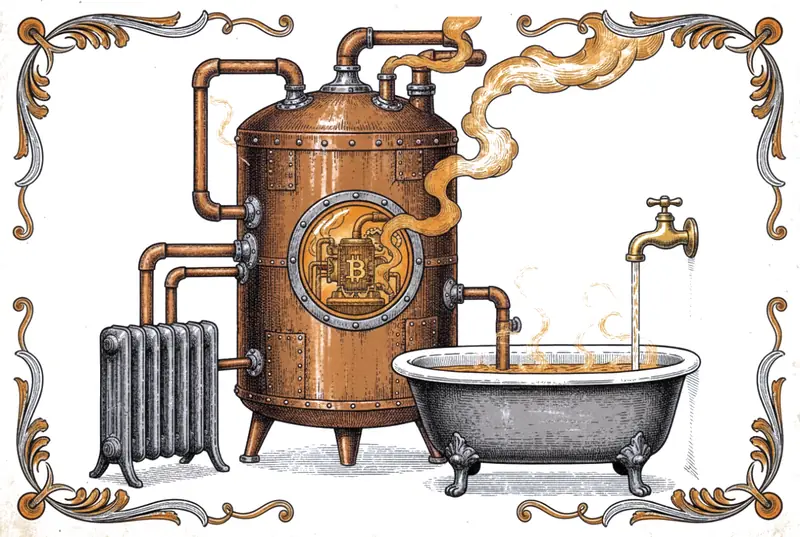
How much heat does a bitcoin miner generate?
Quick answer: about as much as the electricity it draws: an 800 W miner behaves like an 800 W space heater.
According to MARA, a mining company, nearly all the electricity used by mining servers is converted directly into thermal energy. So 800 W of mining is about 2,730 BTU per hour (our conversion), or 19.2 kWh of heat a day. Moving that heat into a water pipe takes a purpose-built system: a job for licensed professionals, and we give no wiring or plumbing instructions, DIY or otherwise.
When does a bitcoin heater beat a normal heater?
Quick answer: it beats a resistance heater; it doesn't beat a heat pump unless power is very cheap.
A heat pump moves heat instead of making it. The IEA says heat pumps on the market are three to five times more energy efficient than natural gas boilers (2022), and the US Department of Energy says heat pump water heaters can be two to three times more efficient than electric resistance ones (2020).
A worked example with the assumptions in the open: Canaan's Avalon Mini 3 (37.5 TH/s, 800 W, specs from a Hashrate Index blog that doesn't say whether it measured them), hashprice $39.87 (Hashrate Index, 28 September 2026), running 24/7, no pool fees. Gross revenue: about $1.50 a day. The US average residential electricity price was 18.31 cents per kWh in July 2026 (EIA, preliminary).
- Against a resistance heater: the same heat, plus about $1.50 a day in bitcoin.
- Against a heat pump with a COP of 3 (three units of heat per unit of electricity, our assumption): for 19.2 kWh of heat the pump uses 6.4 kWh, the miner 19.2. The extra 12.8 kWh costs more than the $1.50 of revenue whenever power costs more than about $0.117 per kWh. At the US average the balance is about -$0.85 a day.
These are examples, not forecasts. In summer, when you don't need heat, it is plain mining: see Is Bitcoin mining worth it in 2026?.
Why is a miner's heat "lukewarm"?
Quick answer: an air-cooled miner blows warm air; district heating needs much hotter water.
MARA says conventional air-cooled data centres produce heat at roughly 25-35 °C, while district heating networks generally need about 80 °C or more. According to the Hashrate Index data above, the exhaust air of an Avalon Mini 3 runs from about 35 to 55 °C depending on the mode. To go higher you need liquid cooling or heat pumps: MARA reports 50-78 °C from its miners and Canaan about 80 °C.
Who is really doing it? Cases with sources
Quick answer: real projects exist, mostly told by the companies. A 2023 MIT working paper said heat reuse looked limited to pilot projects (WP 2023-11).
| Case | What the source says | Who says it |
|---|---|---|
| MARA, Finland (2025) | Satakunta: 3.5 MW of heat at 55-78 °C. Seinäjoki: 1 MW at 50-60 °C plus 0.25 MW from heat pumps to reach 95 °C at peak; customer Seinäjoen Energia | per MARA (page) |
| Canaan, Nordic region (May 2026) | 8 MW project, about 2 MW running, about 2,800 homes expected, around 80 °C; partner and country not named | per Canaan, via TheEnergyMag |
| GDA, Sweden (August 2024) | Norsjö: hot air at 52 °C for a 1,200 m² garage, over 500 kW, 150 machines | per GDA, via Intelligent CIO |
| Mintgreen, North Vancouver (Canada) | Described in March 2022 as a partnership with Lonsdale Energy; Mintgreen says it recovers over 96% of the electricity as heat. We found no confirmation that heat was ever delivered to the network | per Mintgreen, via District Energy |
Can I buy a bitcoin heater for my home?
Quick answer: yes, but the figures are the companies'.
Heatbit's official page presents the Bitair: 25 W, 1.2 TH/s, 25 to 44 dB, also sold as an air purifier, at $179. It says earnings are not guaranteed and that a solo miner's odds of finding a block are 1 in 17,200 a year. Canaan introduced the Avalon Mini 3 as a miner that warms rooms, at $899 on pre-order, according to its statement (The Block, January 2025). For "bitcoin water boilers" with a built-in miner we found no verifiable official spec sheets, so we quote no figures.
What about noise and safety?
An Antminer S21 XP makes 75 dB according to Kryptex; the Avalon Mini 3 about 33 to 55 dB by mode according to the Hashrate Index data; Heatbit claims 25-44 dB. Connecting a miner to electrical or plumbing systems is a job for a licensed professional.
Frequently asked questions
Does a bitcoin heater really work?
As a heater, yes: almost all the electricity becomes heat. As a money-maker, nothing is guaranteed (Heatbit's own page puts a solo block at 1 in 17,200 a year for a 1.2 TH/s unit).
How much heat does a bitcoin miner generate?
About as much as the power it draws: 800 W of mining is roughly 800 W of heat, or about 2,730 BTU an hour.
Is a bitcoin heater cheaper than a normal heater?
Against a resistance heater, it adds some revenue. Against a heat pump it uses about three times the power for the same heat, so it only wins if power is very cheap (about $0.117 per kWh or less in our example).
What is a bitcoin water boiler?
A device that uses a miner's heat to warm water. We found no verifiable official spec sheets for the products on sale, so compare claims carefully.
Not financial advice
This article explains how a miner's heat works. It is not financial advice or investment advice: it says nothing about what to buy and promises no earnings. The calculations are examples.
Sources
- MARA, Beyond the blockchain: how bitcoin mining powers clean, low-cost district heating (30 July 2025, company).
- IEA, The Future of Heat Pumps, executive summary (2022).
- US Department of Energy, Better Buildings Residential Network, Heat Pump Water Heaters: What You Need to Know Right Now (27 February 2020).
- Hashrate Index, Canaan Avalon Mini 3 (27 May 2025, promotional blog).
- Hashrate Index Roundup, 28 September 2026.
- U.S. EIA, Electric Power Monthly, Table 5.6.A (July 2026, preliminary).
- MIT CEEPR, WP 2023-11 (June 2023).
- TheEnergyMag (trade press), Canaan and heat in the Nordics (19 May 2026): Canaan's figures.
- Intelligent CIO (trade press), GDA, Norsjö (21 August 2024): GDA's figures.
- District Energy Association, This Canadian city will be heated by Bitcoin mining (10 March 2022): Mintgreen's statements.
- Heatbit (official page, read 14 October 2026): company statements.
- The Block (trade press), Canaan unveils Avalon Mini 3 (8 January 2025): Canaan's statement.
- Kryptex, Antminer S21 XP (noise; page updated 13 October 2026).